


Natalie Angier will answer select reader questions regarding this column. E-mail your questions to askscience@nytimes.com. E-mails may be published. Answers will be posted on nytimes.com/science on Friday.
Monday, January 29, 2007
Fear and Friends - with benefits
A Life Lived in Fear, but Not Half Bad

Stewart Cairns for The New York Times
UNEASY STREET Allen Shawn at his Vermont home; the multi-phobic composer says his life, at least outside his house, is like “going through a maze.”
BENNINGTON, Vt.
Skip to next paragraph  Valentine by Allen Shawn (mp3)
Valentine by Allen Shawn (mp3) Stewart Cairns for The New York Times
HOMEBODY Mr. Shawn in his kitchen. His phobias have kept him from seeing many of his compositions performed.
THE author’s beautiful live-in girlfriend is asleep upstairs, the author himself is relaxing in his workroom, having just returned from a recording session in New York City. His life looks pretty good.
So the question for Allen Shawn — whose new book, “Wish I Could Be There: Notes From a Phobic Life,” relates his fears of open spaces, closed spaces, highways, subways, elevators, planes, tunnels and the road not traveled — goes to veracity.
Are you really that phobic, Mr. Shawn? Because you’ve been away from your home turf for days, recording an opera you wrote with your brother, and recording studios are sealed and small.
“I do find recording studios, if they are not accessible by stairs and are nowhere near an open window, I do find that very claustrophobic,” says Mr. Shawn, a composer and professor of music at Bennington College who at 5 foot 2 sits on a stack of music when he plays his piano. In this case, though, the studio was a large hall, at the American Academy of Arts and Letters, so it was not a problem.
“My life is a bit like going through a maze, created by my own limitations,” he says. “If that studio was on the 30th floor, I might have made another decision.”
A follow-up question: How did a guy who is afraid of his shadow end up with a beautiful girlfriend — who from the pictures around the house is a good deal younger?
“Oy, yoy, yoy,” Mr. Shawn says, using an expression that his late father, the longtime editor of The New Yorker, William Shawn, who did not exactly advertise that he was Jewish, is unlikely to have uttered publicly. “You didn’t mention short. Um, I really can’t account for it. It’s sort of not for me to say. I admit it’s surprising. You know, I must have my good sides.”
Mr. Shawn is 58, smart and playful, with an amiable and deft style of deflecting questions. He might be the product of a tribe of literary and clever Hobbits, at whose cocktail parties difficult subjects are rendered amusing, and the intrusive and potentially hurtful is quashed. (Were your phobias, including your inability to motor on any but the service roads of Middle Earth, related to the breakup of your marriage? Reply: “I don’t want to go into it. All I can say is the phobias are part of who I am.”)
Mr. Shawn’s former wife, to whom he was married for 25 years and with whom he has a daughter and a son, is the writer Jamaica Kincaid, who at six feet tall towered over him, and who is known, interestingly enough, for being plain-spoken and fearless. (Ms. Kincaid, who left The New Yorker during Tina Brown’s tenure as editor, told Salon that Ms. Brown had some nice qualities, but was attracted to “the coarse and vulgar.”)
Given his phobias, was it particularly hard for him to give up his previous home in Bennington when he divorced five years ago? “To be honest, it paled beside everything else I was leaving,” he says, but then adds, “If the home is a symbol of where you are, then you’re leaving where you are in every sense. It’s just a huge crisis. It’s no longer just a symbol, it’s actually true that you are losing a part of yourself and you are going to have to rebuild a sense of where your center is.”
Mr. Shawn now lives in a little red house on the Bennington campus, which he shares with his girlfriend, Yoshiko Sato, a pianist. But for the skylight in his workroom, the small rooms and low ceilings would suggest an old Vermont farmhouse. A sofa, which came with the house, is used by one of the two cats as a scratching post, with not a word of protest from Mr. Shawn.
He treasures the upright piano, a gift from his father; the photos of his daughter, Annie, 22, and son, Harold, 18, on the workroom walls; the Formica kitchen table at which he ate as a boy with his older brother, Wallace, and his twin sister, Mary. Wallace grew up to be the playwright and actor. Mary, who was mentally impaired, was institutionalized at the age of 8.
Mr. Shawn’s book, published by Viking, alternates between scientific explorations of phobias and his own life and fears. He writes about the terror and confusion he felt when his twin was sent away, and about the many forbidden subjects in his family — money, being Jewish, his sister, his father’s 40-year-long relationship with the writer Lillian Ross. Allen Shawn never knew of that affair while he was growing up — a triumph of emotional self-editing, since there was a separate telephone line for Ms. Ross and when his father received a call from her, he disappeared with the phone into a closet.
Even now, Mr. Shawn does not volunteer details. How old was he when he found out? Nearing 30. How did he find out? It’s a difficult subject, Mr. Shawn says; one of the many people who knew about the affair finally spoke of it. “This person was a bit angry at men at the time and mentioned it within the context of a speech in which she was speaking disparagingly of the way men behave, blah blah.” Mr. Shawn’s phobias have not prevented him from some success as a composer. But his fears have kept him from seeing his own compositions performed and accepting award nominations and overseas commissions. They also affected his family. “This aspect of my life impacts any intimate relationship,” Mr. Shawn says. “It’s terrible to live with a guy who has bizarre rules about what to do and how to do it. From the outside perspective it is a big pain. Not taking decent, normal vacations, not going to a spouse’s or girlfriend’s country of origin because it means crossing an ocean.”
Ms. Kincaid grew up in Antigua. Mr. Shawn never saw where his wife had grown up?
No, he did not.
“Terrible, terrible,” he says. “I didn’t get to her mother’s funeral.”
“It’s a part of what comes with me and it’s a big pain. Imagine: So-and-so invites us to a delightful weekend on their island in Maine. Just picture living with someone like that, who says, ‘I guess you’ll have a good time, dear.’ ”
Mr. Shawn’s phobias also affect his relationship with Ms. Sato. He has never traveled with her to Paris, a city they both love. She has been with him in new restaurants in unfamiliar cities, where he was so anxious he shut down “as if the power was turned off.”
And elevators? “Certainly I’ve taken some small elevator rides with her,” Mr. Shawn says. He laughs painfully. “Sometimes I think I should be shot.”
Enough talk of phobia. Let’s hear about his work.
“You can take it from me, a lot of my music has tremendous anxiety and intensity,” Mr. Shawn says. “But a lot of my music is very joyful and outgoing.”
He sits at the piano and plays a piece called “Valentine.” Unsurprisingly, he is unwilling to say for whom the piece was written. As he plays, the room is filled with music that seems to promise a lifetime of love. The mystery of why a woman would stay with a fearful piano player is gone.
Check Out My Other Blogs (click on blog name to go there) = / 1.3rd Eye Blog / 2. Favorites Blog/ 3. Vita Excolatur (Living Well ...) Blog/ 4. Humor Me Blog/ 5. News and Current Events Blog/ 6. Consider This ... Blog/ 7. Consumer Warnings Blog/ 8. New Orleans Pentimento Blog/ 9. We Constant Gardeners Blog/ 10. Chaillot Family Blog/
Friday, January 26, 2007
Parking Power
Park, He Said
IT was only a matter of time before someone was able to spot the test driver deep within me. O.K., test parker: I was asked if I would do a road test of the self-parking device on the new Lexus LS 460 L. Although I like to think that I was being perceived as a laconic man with steel nerves and steady hands, I suspect that the invitation had something to do with my authorship of “Tepper Isn’t Going Out,” which is considered by most scholars to have been the first parking novel. It might even have had something to do with the fact that in 1964 I was the founding co-editor of Beautiful Spot: A Magazine of Parking, which I’ve seen referred to as a one-issue publication even though we prefer to say that the second issue hasn’t come out yet. (We’ve had some production difficulties.)
If I were asked to name my talent — talent, that is, in the way the Miss America pageant uses the word talent, as in “Miss West Virginia will now do her talent” — I would say “parallel parking.” For the second issue of Beautiful Spot: A Magazine of Parking, I’ve been preparing an article on how I came up with the term “slicing the bread” to describe maneuvering into a spot that leaves only the width of a bread slice between your bumpers and the bumpers of the cars ahead of and behind you. In a later issue, I intend to discuss “breaking the matzo” — getting into a spot so small that a matzo would crack if you tried to place it between the relevant bumpers. Just for the record, the last time I broke a matzo was May 1994, on Riverside Drive, between 83rd and 84th; unfortunately, there were no witnesses.
Video
So I didn’t actually need what Lexus calls an Advanced Parking Guidance System to help me park. On the other hand, even though I consider myself pretty good at washing pots and pans, I wouldn’t hesitate to hand that chore over to an advanced scullery system. So I told the Lexus man to bring the car around to my house. I said that I’d stand on the sidewalk nearby, say “Park!” in a commanding tone, and watch the Lexus LS 460 L do its stuff. He told me that wasn’t how the Advanced Parking Guidance System worked. I told him to bring the Lexus LS 460 L around to my house anyway: I had already alerted the neighbors.
The first thing the Lexus man did was to ask whether I wanted a massage. I looked at him for a few moments, hoping to ascertain if he was trying to get fresh. Test drivers face that sort of thing all the time. Then he explained that the Executive Seating Package (something similar to what I used to refer to as the back seat) included a shiatsu massage function. I had a massage. Then I got behind the wheel and we set out to find a beautiful spot.
Well, not exactly a beautiful spot. A spot that is worthy of that name — a truly satisfying spot, a spot good enough to spin yarns about in bars where parkers gather — requires some skill to get into. The Advanced Parking Guidance System works only if the spot is six and a half feet longer than the car — the sort of spot, in other words, that the average Manhattan parker comes upon about once every 14 or 15 years. The only parker who might need help from a guidance system to get into such a spot is a parker who is driving himself home from rotator cuff surgery. For Lexus to offer a self-parking system for a spot that size is the equivalent of some high-end kitchen-equipment manufacturer offering a self-carving system that only works on meatloaf.
Still, I can report that for the meatloaf parker, the Advanced Parking Guidance System does work, assuming you have the time to fiddle with the screen long enough to make sure that the little yellow flag is where it’s supposed to be and the box representing the spot is correctly positioned. As you ease up gradually on the brake, the wheel turns on its own to make one reverse swoop into the spot. Watching the wheel turn by itself is a bit like watching a player piano, except in traffic.
“But can it find a spot?” I asked the Lexus man. The Lexus man said the Advanced Parking Guidance System cannot find a spot. That stands to reason. After all, it’s the first self-parking system — the equivalent of a cellphone so primitive that its only function is to make and receive phone calls.
As the competition heats up, improvements are inevitable. I can see Nissan coming out with a screen on its Infinitis that shows the open spaces in a three- or four-block area, with spots near fire plugs or in front of driveways automatically blanked out. Then Mercedes answers with a system capable of finding spots that are what people who deal with New York alternate-side parking regulations call “good for tomorrow.”
Then Lexus fights back. The new Lexis LS 560 or 660 is announced with an advertisement that says, “Our guarantee: You can be the first on your block to break the matzo.”
Check Out My Other Blogs (click on blog name to go there) = / 1.3rd Eye Blog / 2. Favorites Blog/ 3. Vita Excolatur (Living Well ...) Blog/ 4. Humor Me Blog/ 5. News and Current Events Blog/ 6. Consider This ... Blog/ 7. Consumer Warnings Blog/ 8. New Orleans Pentimento Blog/ 9. We Constant Gardeners Blog/ 10. Chaillot Family Blog/
Wiki Parenting
low concept: Dubious and far-fetched ideas.
Wiki-Parenting
How babies invented community-based collaborative authorship.
Posted Wednesday, Jan. 24, 2007, at 4:49 PM ET
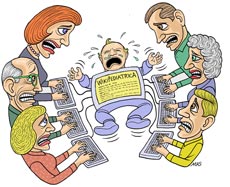 With all due respect to Ward Cunningham, I'd like to take issue, for a moment, with the claim that he is the originator of the wiki. Because anyone who's had a child can assure you that collective public authorship, collaborative editing, and anonymous generative correction—those wiki hallmarks—have been around since Mrs. Cain first brought Baby Cain over to Uncle Abel's house dressed only in a too-thin fig-leaf onesie.
I took my small sons to visit family over the holidays. As invariably happens when one wants to show off one's young, the smaller one's face exploded into great green ropes of snot only seconds after deplaning. The consumptive Victorian wheeze followed mere hours later. And suddenly, he was no longer my baby. He was a server-side wiki.
Now, my husband and I had more or less finalized our wiki entry on caring for babies with colds. We had agreed, for instance, about the germ theory over the outside-with-wet-heads theory. We were, in the main, for hot liquids, baby Tylenol, hand-washing, and humidifiers. But as our boys are increasingly exposed to a growing number of end users, the markups of their illness wiki began to proliferate.

One of the great-aunts quickly submitted the milk markup. "No milk, no cheese, no yogurt," she wrote definitively. I went back that afternoon and edited this out. "The pediatrician has assured us that there is absolutely no connection between dairy and mucous," I wrote. My mom was spurred on to correct my error. "Absolutely no milk," she marked up my markup. "Also, no baths!"
When the baby started to smell funny that night, I checked his wiki for any Recent Changes. I noted the no-baths entry with some surprise and responded with a hasty edit: "Baths are okay," I wrote. "He finds them very soothing, and they are better than a sandblaster for the welded-on green mucous."
By the morning, "definitely no baths" had been reinstated, and "warmer slippers and indoor hats" had been added in by the lady at the supermarket who heard him coughing in the checkout line. Beginning to doubt myself and the gurus from What to Expect the First Year, I found myself mulling over these modifications. "Should we really be overheating him if it isn't cold out?" I typed into the comments section.
"He needs to sweat it out," responded a former law school classmate, who had also gone in and deleted the "baby Tylenol" entry, noting that suppressing a fever is a mistake, as is preventing the mucous from circulating freely. A visit to the local pediatrician that day prompted a similar entry, even as my big brother was editing the "slippers and hats" instructions and replacing it with "plenty of crisp fresh air." Then suddenly, my house was divided against itself, as my husband abruptly changed course, finding himself in agreement with the sweatiness/free-range-mucous camp.
I surreptitiously deleted these entries following the baby's 3 a.m. coughing fit/antihistamine fix. When I awoke that morning, the patient was bundled in 13 alpaca throw rugs and the wiki entry had been marked up to reflect that "Both Tylenol and decongestants should be discouraged. The child must rid himself of his bodily flooids naturally." I could tell from the spelling that my older son was the poster.
"No wheat or refined sugars" had been added next to the "no dairy" section. "Only fresh fruit and vegetables and warmed broth." But by that afternoon, "broth" had been deleted and "Glenfiddich" had been added. My brother again. Next to that was the "vitamin C and Echinacea" entry, and beneath it was something from a cousin's homeopath about fashioning a tiny anklet out of chicken bones. The chicken bones were out by midafternoon, but the chicken soup was in. Handy hypertext recipe. Great-aunt again.
In between checking the shifting wiki entries, I would poke my head in on the baby, who was now soaking outside in a tub of lukewarm Glenfiddich in a bonnet made of celery, with vitamin C tablets in his ear.
Miraculously, the next morning he was cured.
That morning, there was also a new entry in the wiki, and the telltale green snot on my keyboard suggested that the 20-month-old had proven the adage that one is never too young to wiki. "It may take a wiki to raise a child," I read. "But could somebody please get in here and change my diaper?"
Check Out My Other Blogs (click on blog name to go there) = / 1.3rd Eye Blog / 2. Favorites Blog/ 3. Vita Excolatur (Living Well ...) Blog/ 4. Humor Me Blog/ 5. News and Current Events Blog/ 6. Consider This ... Blog/ 7. Consumer Warnings Blog/ 8. New Orleans Pentimento Blog/ 9. We Constant Gardeners Blog/ 10. Chaillot Family Blog/
Wednesday, January 24, 2007
Timeless
Making Sense of Time, Earthbound and Otherwise

More than three weeks have passed since the great Waterford disco ball dropped over Times Square, and most of us are taking 2007 in stride. The time is flying by, just as it does when we’re having fun, approaching a deadline or taking a standardized test on which our entire future depends, though not, oddly enough, when we ourselves are flying, especially not when we are seated in the last row, near the bathrooms.

But before we stuff the changing of the annum into the seat pocket in front of us and hope that nobody notices, it’s worth considering some of the main astral and terrestrial events that make delightful concepts like “new year” and “another Gary Larson calendar” possible in the first place. Let’s think about the nature of so-called ordinary time, the seconds, days, seasons and years by which we humans calibrate our clocks and merrily spend down our lives. As Robert L. Jaffe, a theoretical physicist at M.I.T., explained in an interview and recent articles in Natural History magazine, our earthly cycles and pacemakers are freakish in their moderation, very different from the other major chronometers that abound around us, but of which we remain largely unaware.
The long and short of the universe is just that, almost exclusively long and short, with the hyperclipped quantum clickings of the atom on one end and the chasmic lollygags and foot drags of the greater cosmos on the other. We terrestrial, tweener-timed life forms are the real outliers here, the kinky boots at the party.
So what are the public and private rhythms by which we humans abide? Our prima donna of a planet twirls on its axis once every 24 hours and so gives us our days, and as it rotates it circumnavigates the sun to sketch out our 365-day years; and because the angle of Earth’s spin relative to the big, flat platter of its orbit isn’t straight up and down, but instead is tipped by 23 degrees, we have our seasons, our cashmere and cotton, the heartbreak of clothing moths.
These cycles have been in place at more or less their current configurations since the birth of Earth more than four billion years ago, and they have set the dials and counters of virtually all life. Every cell of the human body pulses to a circadian beat, sucking in glucose, squirting out hormones, building up fresh proteins and breaking down stale ones, all in predictable swells and troughs throughout the day, a rhythmicity that may help explain why we love music but still does not explain the lingering popularity of Bachman-Turner Overdrive.
Elsewhere in the solar system are other worlds, taking care of their business, working their quirky times. Saturn, for example, spins as snappily as it accessorizes, completing a day in 10½ hours; but being almost 10 times farther from the Sun than we are, it needs 30 of our years to finish one of its own. Mercury, by contrast, orbits the Sun in just 88 days, but rotates a miserly one and a half times during the entire mercurial “year,” which means that the side facing the sun has a chance to bake to 700 degrees Fahrenheit, while the half staring out into space turns as cold and miserable as that poor little demotee from the planetary pantheon, Pluto.
These various blends of diurnal and annual cycles are all perfectly comprehensible, if medically ill-advised. But just as the light that we humans deem “visible” represents a tiny part of the vast electromagnetic spectrum, so the collected clocks of the solar system are a meager sampling of the universal stock of tockers. Far more action is going on below the surface, in the subatomic community. There we find events occurring in increments far briefer than classic quickies like “in a heartbeat” (i.e., about a second) or “in the blink of an eye” (a tenth of a second), and down into the realms of scientific notation blessedly leavened with Marx Brothers nicknames — intervals like the attosecond (a millionth of a trillionth of a second, or 10-18 second), the zeptosecond (a billionth of a trillionth or 10-21 second) and, my personal favorite, the yoctosecond (a trillionth of a trillionth, or 10-24 second). No matter the nomenclature; the duck soup is ever astir. The time it takes a quark particle to circle around inside the proton of an atomic nucleus? Midway between zepto and yocto, or roughly 10-22-16 second. second. For an electron to orbit the proton to which it is madly, electromagnetically attracted? A not-quite-atto-sized 10
Fleeting does not mean flaky or unstable, however. To the contrary: the fundamental quivers of the atom “are exceedingly regular,” Dr. Jaffe said, adding, “They mark the heartbeat of the universe.” Atomic events are so reliable, so like clockwork in their behavior, that we have started tuning our macroscopic timepieces to their standards, and our beloved second, once defined as a fraction of a solar day, is now officially linked to oscillations in a cesium atom.
Or look to the expanding firmaments, the unspeakably protracted pace of the space race. Cosmic time is as difficult to grasp as the twitchings of the atom, but it, too, is rule bound and reliable. Galaxies and clusters of galaxies are moving away from one another in defined intervals as the space between them expands like the rubber skin of an inflating balloon. They have been sailing outward from one another for nearly 14 billion years, since the staggering, soundless kaboom of the Big Bang set this and all clocks ticking, and they will continue their dispersal for tens of billions, hundreds of billions of years more.
We are poised between the extremities and homogeneities of nature, between delirium and ad infinitum, and our andante tempo may be the best, possibly the only pace open to us, or even to life generally. If we assume that whatever other intelligent beings that may be out there, in whatever alpha, beta or zepto barrio of the galaxy they may call home, arose through the gradual tragicomic tinkerings of natural selection, then they may well live lives proportioned much like ours, not too long and not too short. They’re dressed in a good pair of walking boots and taking it a day at a time. And if you listen closely you can hear them singing gibberish that sounds like Auld Lang Syne.
Check Out My Other Blogs (click on blog name to go there) = / 1.3rd Eye Blog / 2. Favorites Blog/ 3. Vita Excolatur (Living Well ...) Blog/ 4. Humor Me Blog/ 5. News and Current Events Blog/ 6. Consider This ... Blog/ 7. Consumer Warnings Blog/ 8. New Orleans Pentimento Blog/ 9. We Constant Gardeners Blog/ 10. Chaillot Family Blog/
Sunday, January 21, 2007
Diet, exercise for nought
Man of the House
Temptation is everywhere
You primp. You diet. You work out. And for what?
MY FAVORITE recent celebrity article, here in the City of Self-Denial, is about an actress and her favorite L.A. breakfast diner. In the article, she said she loved the joint because the smell of bacon really permeated the place. She explained that, since she's a vegetarian, she never actually orders the bacon. But she really loves the smell.
Me, I eat the bacon.
ADVERTISEMENT

Thing is, functional people are all a little nuts. God, please watch over the soul of a rational man in this irrational world. The odds are so against him.
Take me. Please.
In the next room, I can hear my wife primping for bed. Each night, the routine is the same. She flushes. She brushes. She flosses. A cupboard door opens. A cupboard closes, thud-dum. The water runs in the sink. Long silence. Another flush. A cough. Some gargling. Some clipping. The rasp of an emery board. I think I hear a power drill. A cupboard door opens again, a cupboard closes.
Thud-dum.
This goes on for about an hour and a half. I know her pre-bed routine the way I know the national anthem. Against all odds, I wait for her to show up. The Donald has a better chance of romancing Rosie.
Finally, my wife slowly lifts the sheets and slides into the sack. Then she gets up out of bed to help the beagle up into the bed. Then she slides back into bed. Then she gets up again to help the cat. Then the other dog. There are now five of us in bed, and I am the only one she has not touched. The temperature of the sheets? About 2,000 degrees.
"Where you going?" I ask when she gets up yet again.
"Forgot to turn on the dishwasher," she says.
Forget anything else, honey?
At the gym each morning, I try to keep myself in shape for her — healthy, trim, supple. In the event of actual intimacy, I don't want to tear a muscle.
So each weekday I rise at 5:30 a.m., get to the gym and find the parking lot nearly full.
"Do these people ever sleep?" I wonder. "I know they don't eat. But don't they even sleep?"
Seriously, L.A. is the only city in the world where eating is considered an inconvenience. But I thought they'd at least catch a little shut-eye. No.
Anyway, the gym is packed every morning in early January, and still I go. The treadmills are full. The busy pool is whipped into 3-foot waves. Even the weight room's bustling. Sure enough, misery loves company.
The best bods, by the way, belong to the divorced women. It's as if they've tapped into some fountain of youth, when really all many of them did was call Dr. Melman for a tuneup of the tummy, the chest, the squishy derrière.
I'd like to think that, had they called Dr. Melman a little sooner, they'd all still be married. But divorce is way more complicated than that, my wife tells me — though I tend to tune out when she gets to the part about men needing to listen better.
Truth is, I need Dr. Melman too. Maybe he can cinch up my hamstring, the one I tore while jumping out of my chair during the Boise State game. As any athlete knows, pulling a hamstring is the equivalent of breaking a bone.
So I tried to sell my lovely bride on a little round of a new home therapy: spank-u-puncture. It's a new treatment I dreamed up, a combo of mild corporal punishment and traditional acupuncture. It stimulates nerve endings even as it deadens them. It cures about anything, including cold sores and mild depression. Just wait till the oversexed gang on "Grey's Anatomy" hears about this.
Of course, my bride wouldn't agree to any spank-u-puncture, after a whispery late-night dispute over which one of us would be the spanker and who would be the spankee. (Guess for yourself, OK? I try to be pretty private with my private life.)
Needless to say, spank-u-puncture remains a promising but still unproven medical-marital breakthrough. I see a big future for it. Eventually, I hope to do for spanking what that Jarvik dude did for plastic tickers.
Till then, I will wait in bed each night, though the primping, the flushing, the brushing, the dogs …
Life is nuts, isn't it? So go ahead, girl. Eat the stupid bacon.
Chris Erskine can be reached at chris.erskine@latimes.com. His MySpace address is myspace.com/chriserskine.
Check Out My Other Blogs (click on blog name to go there) = / 1.3rd Eye Blog / 2. Favorites Blog/ 3. Vita Excolatur (Living Well ...) Blog/ 4. Humor Me Blog/ 5. News and Current Events Blog/ 6. Consider This ... Blog/ 7. Consumer Warnings Blog/ 8. New Orleans Pentimento Blog/ 9. We Constant Gardeners Blog/ 10. Chaillot Family Blog/
French Twist
Mr. and Mrs. Natural

VALLÉE DU Vidourle, France
Skip to next paragraph 


Multimedia

Allen Salken/The New York Times
Robert and Aline Crumb in the kitchen of their partly 11th-century home in France.
From “The R. Crumb Handbook” by R. Crumb and Peter Poplaski, 2005, MQ Publications
The cover of one of Mr. Crumb's comics.
From “Need More Love” by Aline Kominsky Crumb, 2007, MQ Publications
An illustration from Ms. Crumb’s book.
Allen Salken/The New York Times
The doorbell.
SHORTLY after Robert and Aline Crumb moved from the United States to a small village in this valley in the South of France, they were asked to participate in a summer medieval festival. For the event local politicians don robes like those once worn by feudal lords, and most of the citizens wear peasant rags.
Mr. Crumb, timid, like the famous cartoon caricature of himself he draws in his comic strips, is not one for parades. The father of Fritz the Cat, Mr. Natural and Devil Girl declined to participate.
Ms. Crumb, bold, like the red-haired cartoon version of herself she draws, agreed to join the procession and asked for the cotton rags. The festival organizers would not hear of it. “They told me, ‘No, you have to get a costume of a lady in waiting because your husband is an important person,’ ” Ms. Crumb, 59, recalled over breakfast at their 13-room house, parts of which date from the 11th century.
Although the brocaded costume was stiflingly hot — “I felt like a giant sweating chair,” Ms. Crumb said — it turns out the townsfolk were prescient. In a twist as unlikely as the plot of an R. Crumb comic, the couple, known to many from the 1994 documentary “Crumb,” which portrayed Mr. Crumb’s troubled early family life and adult predilection for riding piggyback on large women, have become something of a lord and lady in their village. They are surrounded by a bohemian court of artists, lovers, sycophants and jesters engaged in fits of intrigue.
“We live in Crumbland,” Ms. Crumb said.
They moved to France 16 years ago, sickened, they said, by the infiltration of their once sleepy California town, Winters, by newcomers who bulldozed hilltops for McMansions. The Crumbs also wanted to shield their daughter, Sophie, from a growing conservative and fundamentalist Christian influence while continuing to educate her in what they consider the classics. They reared her on “Little Lulu” comics from the 1940s and ’50s and Three Stooges videos.
It was Mr. Crumb’s absorption of such popular culture that led to his signature style. He applied a lowbrow, all but forgotten crosshatched technique to a kaleidoscope of sexual fantasies, controversial racial topics and images of the hippy counterculture. In so doing, he laid the groundwork for adult-theme graphic novels, influencing everyone from Daniel Clowes, the creator of “Ghost World,” to Art Spiegelman, the author of “Maus.”
“He’s a monolithic presence, who rewrote the rules of what comics are,” Mr. Spiegelman said.
Much of Crumbland’s energy is devoted to preserving space for Mr. Crumb, 63, to continue his work and for everyone to feed off it.
When the Crumbs moved to their village west of Nîmes — which they asked not be named, fearful of attracting streams of fans — many old houses were empty. Villagers preferred modern homes with square rooms across the river, where streets are wide enough for two cars to pass.
But since the Crumbs’ arrival, many of the achingly quaint, empty stone houses have attracted other newcomers. One of the first was Ms. Crumb’s brother, Alex Goldsmith, who lives in the lower ramparts of the Crumb home. Mr. Goldsmith, 54, said he had fought drug addiction, and if his sister had not welcomed him to France, “I’d probably be in prison, if I was alive.”
He earns money buying used R. Crumb comics on eBay, taking them upstairs for Mr. Crumb to sign and reselling them “for quadruple” on the Internet, Mr. Goldsmith said, smiling.
For years, Mr. Crumb would occupy his time waiting to be served at village restaurants by doodling on place mats. When his New York agent, Paul Morris, said that he had a market for the drawings, Ms. Crumb offered to help one restaurateur sell his collection. They fetched $25,000. A pizzeria sold its R. Crumb doodles to Mr. Morris for $2,500 each.
Another village newcomer is Christian Coudurès, a printmaker, who moved from Paris. When he was depressed after breaking up with a girlfriend, Ms. Crumb decided he was a project she wanted to take on.
“When I first met him, he was in bad shape, drinking a lot,” she said. “I decided I needed to save this worthy person.” Mr. Coudurès eventually became what Ms. Crumb calls her “second husband.”
The Crumbs have long had an open marriage, that brave (and largely discarded) institution of the 1960s. Mr. Crumb travels to Oregon once a year to rekindle a relationship with an old girlfriend.
Speaking of Mr. Coudurès, Mr. Crumb said, “Between the two of us, we kind of make an ideal husband, because he can do all the masculine things I can’t do.” He cited Mr. Coudurès’s talents for wiring, plumbing, engaging in shouting matches with the highly energetic Ms. Crumb and driving a car.
“If she ever started making comparisons about our lovemaking technique, I might get jealous,” Mr. Crumb added.
Their daughter, Sophie, is not so sure about the arrangement. She called the idea of her mother’s having a second husband “gross.”
Nonetheless, the strong-jawed Mr. Coudurès, 61, has become a part of the support system that frees Mr. Crumb to focus on work. The Frenchman, who has a thick mane of black hair, does handyman chores. His daughter Agathe McCamy, 35, helps Ms. Crumb color her comics.
“I am a Situationist,” Mr. Coudurès explained in French after sharing a dinner with the Crumbs next to a gently crackling fireplace in his kitchen. He was referring to a European avant-garde philosophy born in 1957 and championed by Guy Debord. “I am an adventurer of the present.”
Mr. Crumb’s current project has him spending a lot of time in the past. He is illustrating the opening book of the Bible, Genesis, and spends hours in his study deep in the Crumb house consulting translations of Sumerian legends, Hebrew and Christian scholarly interpretations of the Bible and reproductions of illuminated manuscripts.
The work contains biblical scenes populated with classic R. Crumb women, their legs and ankles hearty, their breasts straining through flimsy dresses. But the work is not sexually graphic. Nor has the artist altered a word of the Genesis text.
Mr. Crumb has calmed considerably since his early days, when he was so afraid of social interaction that he focused all of his energy on drawing. “I basically lived on paper,” he said, reclining on a small wicker couch in his study, where the shelves are packed with vintage 78 r.p.m. records, comic book figurines and back issues of Fate, a magazine of the paranormal.
In recent years he has taken to sitting in a chair every morning and meditating for 45 minutes, following the rising and falling of his breath. The resulting inner calm has changed his vibe. As a younger man he was a gerbil-like creature with a whiskery mustache and a twitchy demeanor. Now he seems more like a small Lincoln or van Gogh, a bearded, although still bony, thinker with a certain gravity.
“He’s less wimpy,” said Sophie Crumb, now 25, who lives in a village a half-hour drive from her parents with her American boyfriend.
She is still mentally processing her upbringing. “It’s weird, the mixture of the culture of California, France and underground comics, this random strange mixture of things that don’t add up at all,” she said, sitting with her dog, Poopsie, in a sidewalk cafe. Trying to learn a new language and to fit in at school with French children made her “really good at adapting,” she said.
Now a cartoonist herself, Sophie Crumb has work in Mome, a comics quarterly, and she is coloring “Genesis Illustrated.”
Comics have always bound the Crumbs. Aline and Robert met in 1971 after she heard about a large-rumped woman named Honeybunch Kaminski created by Mr. Crumb for his Snatch Comics series. Ms. Crumb, whose surname from her first marriage was Kominsky, bore a physical resemblance to Honeybunch, and she set out to meet the famous R. Crumb.
“She was the first woman I met whose emotions didn’t scare me,” Mr. Crumb said.
They began drawing comics together in 1974. Many readers of their occasional reportage-style comics in The New Yorker, where they have written about the Cannes Film Festival and New York Fashion Week, do not realize that Ms. Crumb draws herself in the panels and writes her own dialogue.
Wider recognition may come soon. A graphic memoir, “Need More Love,” including Ms. Crumb’s comic books, paintings and musings, is scheduled to arrive in stores next month. An exhibition of her drawings and other works is scheduled for the Adam Baumgold Gallery in Manhattan, Feb. 15 through March 17. On Feb. 14, Mr. Crumb is scheduled to interview Ms. Crumb at the New York Public Library. (Mr. Coudurès also plans to be present.)
Three times a week Ms. Crumb leads an American-style Pilates-yoga-dance class in her village’s Napoleonic-era barracks. Regulars include Estelle Kohler, a legendary actress with the Royal Shakespeare Company; and a French marionette maker, married to a man who publishes a newsletter about flying kites.
The village seems to be thriving with such free spirits. An Israeli, Khaïm Seligman, set up shop making wooden flutes. Melinda Trucks, the wife of Butch Trucks, the Allman Brothers Band drummer, has taken Ms. Crumb’s exercise class. The Truckses have bought a nearby estate.
A longtime friend of the Crumbs, Peter Poplaski, moved to the village in the ’90s, collaborated with Mr. Crumb on a 2005 collection, “The R. Crumb Handbook,” and continues to work on a pet project he describes as “the quintessential Zorro book of the 21st century.” Mr. Poplaski, a Wisconsin native, dresses as Zorro for festivals to entertain the village children.
Despite her dalliances, Ms. Crumb is fiercely loyal to Mr. Crumb. In addition to overseeing much of his business, she has transformed their labyrinthine home into a sort of Crumb archive and museum.
A narrow stone staircase leads unevenly from a room at the front door to a long hallway, whose ceiling reaches up three floors.
In the hallway hang two abstract oil paintings by Mr. Crumb’s younger brother, Maxon. Mr. Crumb said his brother is in better shape than when he appeared in the documentary, in which he is shown disheveled, meditating on a bed of nails and begging on the streets. Although Maxon still lives in the same room in a San Francisco skid row hotel where he has stayed for a quarter-century, his paintings are fetching healthy prices, and he is in a stable relationship.
Also on the wall is a portrait of Jesse Crumb, Mr. Crumb’s son by his first marriage. They are estranged because of a dispute over a business selling Crumb merchandise, Mr. Crumb said.
Controversy continues to find Mr. Crumb. A poster he drew to protest a proposal to build a large supermarket in the village drew controversy after a local politician whom the artist caricatured filed charges for “insult to a private person.”
But the legal action backfired when it drew the attention of a local newspaper, which ran a front-page article sympathetic to the opponents of the supermarket. This also profited Mr. Goldsmith, who sold a pair of autographed R. Crumb anti-supermarket posters for $385 to a Danish collector.
Despite, or perhaps because of, the dramas around him, Mr. Crumb continues to find the inspiration to produce art.
After dinner one night at Mr. Coudurès’s apartment, Mr. Crumb sat looking at a book his wife’s lover had brought to the table about the World War II escape of many European artists, Jewish and otherwise, via Marseille to New York.
There was a photo of a grandly smiling Salvador Dalí and his wife, Gala, in front of a painting. “He was a real self-promoter, that Dalí,” one dinner guest said.
Mr. Crumb pointed at the wife.
“She was behind most of that,” he said.
Check Out My Other Blogs (click on blog name to go there) = / 1.3rd Eye Blog / 2. Favorites Blog/ 3. Vita Excolatur (Living Well ...) Blog/ 4. Humor Me Blog/ 5. News and Current Events Blog/ 6. Consider This ... Blog/ 7. Consumer Warnings Blog/ 8. New Orleans Pentimento Blog/ 9. We Constant Gardeners Blog/ 10. Chaillot Family Blog/


